The headline
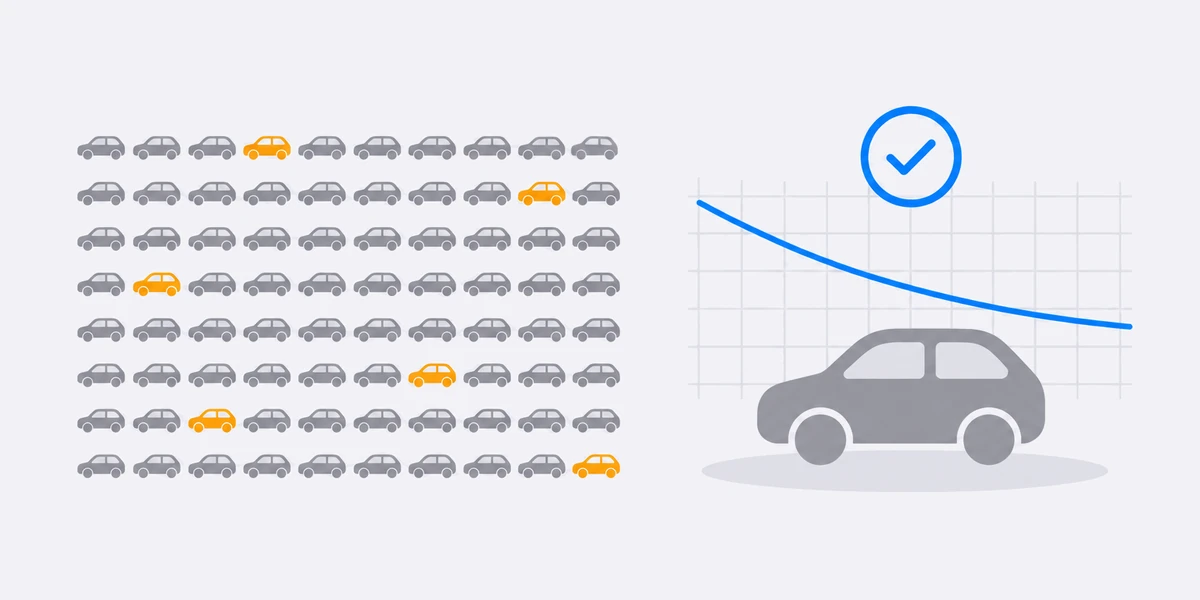
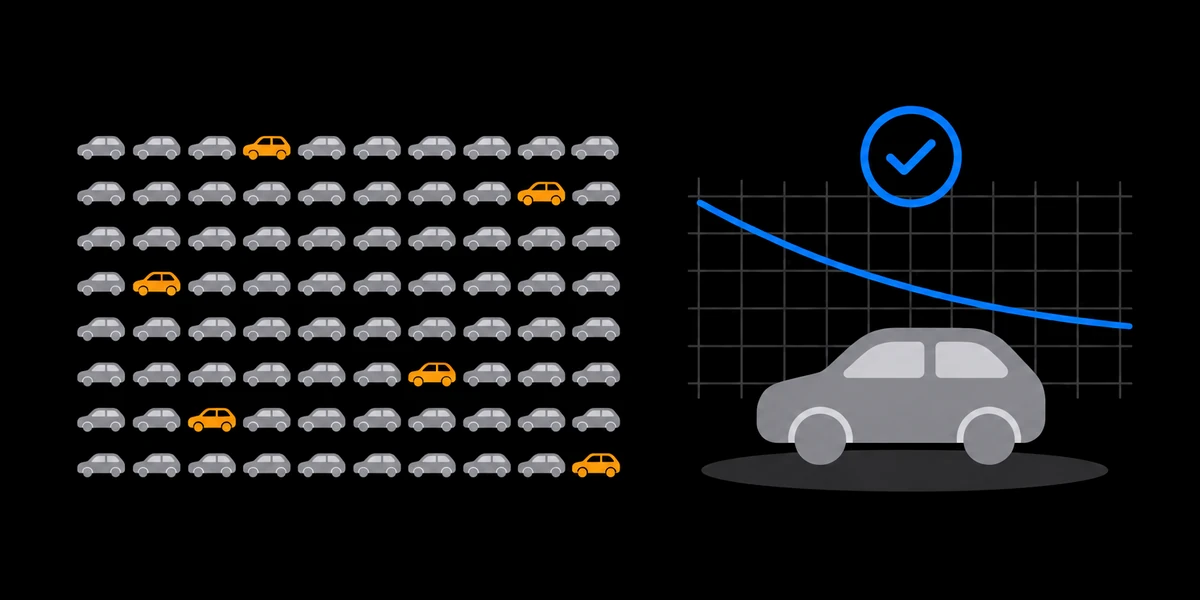
In 2025, by our count, cars and light vans in Great Britain had 34,354,523 initial MOT tests. 76.9% of them ended in a pass, counting faults that were fixed during the test. The fail rate was 23.1%.
That is a change of +0.4 points on 2024, when 76.5% of 34.2 million tests passed. A move this small can come from changes in the mix of cars tested, such as their ages, as much as from the cars themselves.
Every number on this page is a live figure from the RegTail MOT Index 2025, the same data behind our MOT statistics pages and the MOT Explorer. Select any figure to open it in the Explorer at that exact view.
How the pass rate falls with age
Age matters more than anything else in the data. A three year old car having its first MOT passed 89.6% of the time in 2025. At ten years old it was 75.0%, and at fifteen 65.8%.
The curve flattens out in the late teens. The cars still on the road at twenty (64.4% passed) are the survivors: neglected cars have mostly been scrapped by then. A typical ten year old car had covered about 81,000 miles by its MOT.
The best and worst, like for like
Because age matters so much, comparing models on their raw pass rate mostly compares how old their cars are. So we rank models on a like-for-like pass rate: each model's pass rate at every age from 3 to 10, weighted by the same age mix for every model. On that measure, all cars and light vans together scored 82.6%. 142 models had enough tests to be ranked.
The Porsche 911 came top at 95.2%. Sports and luxury cars tend to lead because they cover fewer miles and are often well looked after. For most buyers the more useful names sit just below: the Honda Jazz (91.4%) and the Toyota Prius (91.0%) are common, affordable cars that pass far more often than average.
Vans dominate the bottom of the table. They work harder and cover more miles than cars, and most of the ten lowest are vans, led by the Renault Trafic at 69.7%. The cars among them are the Renault Clio (71.5%) and the Renault Zoe (72.0%).
The most-tested models
The cars Britain tests most are not the ones that pass most often. The Ford Fiesta had more MOT tests than any other model, 1,368,388, and ranked 75th of 142 like for like.
Fuel
By fuel, hybrids passed 89.7% of the time and electric cars 87.2%, against 77.5% for petrol and 74.1% for diesel.
These figures are not age-adjusted. Hybrid and electric cars are a much younger fleet than petrol and diesel cars, and younger cars pass more often. So this does not show that hybrids or electric cars are more reliable. To compare fairly, look at a model's pass rate at a given age on its MOT statistics page.
Mileage
Cars in the lowest mileage band passed 91.5% of the time, and cars in the highest band 67.1%. Mileage is not age-adjusted either: cars with higher mileage are also older.
The most common item on the test was tread depth: at least 15.3% of tests carried a tread depth advisory.
What changed since 2023
- Tests: 33.8 million in 2023, 34.2 million in 2024 and 34.4 million in 2025.
- Pass rate: 76.5% in 2023, 76.5% in 2024 and 76.9% in 2025.
- Ten year old cars: 72.7% passed in 2023 and 75.0% in 2025.
Every year in the index uses one method, so the years can be compared directly. Our earlier article on the most reliable used cars used 2023 tests.
How we did it
Data. The DVSA anonymised MOT tests and results for 2023, 2024 and 2025. Contains public sector information licensed under the Open Government Licence v3.0.
Tests. Initial tests only: retests are left out. Cars and light vans, MOT classes 4 and 7. A pass includes faults fixed during the test.
Age is whole years from first use to the test.
Models are grouped by the first word of the DVSA model name, so "FOCUS ZETEC" and "FOCUS ST" are both the Ford Focus. Names that cover several different models are left out.
Like-for-like pass rate. A model's pass rate at each age from 3 to 10, weighted by the all-car age mix of that test year. A model is ranked with at least 20,000 tests and at least 50 at every age in that range. A model gets its own page with at least 5,000 tests.
Defects count once per test. Only each model's most frequent items are kept, so defect rates are floors: read them as "at least".
Fuel and mileage figures are not age-adjusted.
How to cite
Cite the release, the year and the source:
RegTail MOT Index 2025 (regtail-mot-index-2025-v1). RegTail's analysis of 34,354,523 initial MOT tests in 2025, from the DVSA anonymised MOT dataset. Contains public sector information licensed under the Open Government Licence v3.0.
The release id is regtail-mot-index-2025-v1. Every figure, table and chart is in the downloads as CSV and JSON, and can be explored model by model in the MOT Explorer. Each model page, such as the Ford Fiesta, is a stable citable link.